|
| 2009 Liège-Bastogne-Liège Teams |
![]() |
| Team Rosters and |
|
|
95th Liège-Bastogne-Liège Results 1 Andy Schleck (Lux) Saxo Bank 6.34.32 2 Joaquím Rodríguez (Spa) Caisse d'Epargne 1.17 3 Davide Rebellin (Ita) Diquigiovanni-Androni Giocattoli 1.24 4 Philippe Gilbert (Bel) Silence-Lotto 5 Serguei Ivanov (Rus) Katusha 6 Simon Gerrans (Aus) Cervélo TestTeam 7 Damiano Cunego (Ita) Lampre-NGC 8 Benoît Vaugrenard (Fra) Française des Jeux 9 Alexandr Kolobnev (Rus) Saxo Bank 10 Samuel Sánchez (Spa) Euskaltel-Euskadi 11 Ryder Hesjedal (Can) Garmin-Slipstream <---
Highlights — sporza
Post race talk show... now off the air — tourdetweets
José Serpa slips out cornering over road paint — eurosport germany
It is hard to keep your video camera steady when you are cheering at the same time — spectator
How the race was won — Cosmo Catalano
Start Time: Sunday 10:00 AM CEST ();
Earliest live video: 2:10 PM CEST ();
See all the live video, audio and text options
Approximate Finish: 4:47 PM CEST ()
Rider race/bib numbers, withdrawals and links to rider bios
Current Time, Weather and Wind Direction in Liege, Belgium
Current Situation/Live Updates
| media source | tv or internet | comments/restrictions |
|---|---|---|
live video streaming(restricted) live video streaming(unrestricted) |
Liegi-Bastonge-Liegi starts on RAI Tre at 15:05 CEST (120 min); restricted to Italy; unrestricted options may be available at race time | |
| RTL | live video streaming(unrestricted) |
From Luxembourg TV |
live video streaming(less restricted, use IE8) live video streaming |
NOS TV w/ Dutch ticker; video likely restricted to the Netherlands | |
![]() |
live video streaming |
Luik-Bastenaken-Luik is live on Sporza at 15:10 CEST; likely restricted to Belgium/Europe; live ticker from the start |
live video streaming |
starts at 15:10 CEST (115 min); check back at race time for a likely unrestricted France3 live feed | |
![]() |
live video streaming internet audio |
Some confusion about start time. Update: looks like a 14:00 CEST is the start. |
![]() |
live video streamingrestricted live video streaming(unrestricted) |
rtbf is restricted; french commentary |
![]() |
live video streaming |
North America only; requires a subscription; english commentary |
![]() |
North America; highlights (30 min) preceded by four minutes of La Fléche Wallonne highlights starting at 3PM ET; find versus in your area | |
|
|
|
official live text updates/ticker and key moments |
![]() |
|
live text updates starting at ??:?? CEST () |
![]() |
|
live text updates starting at 8:00 AM ET |
| short text updates from any and everyone | check back at race time for more and updated links; |
|
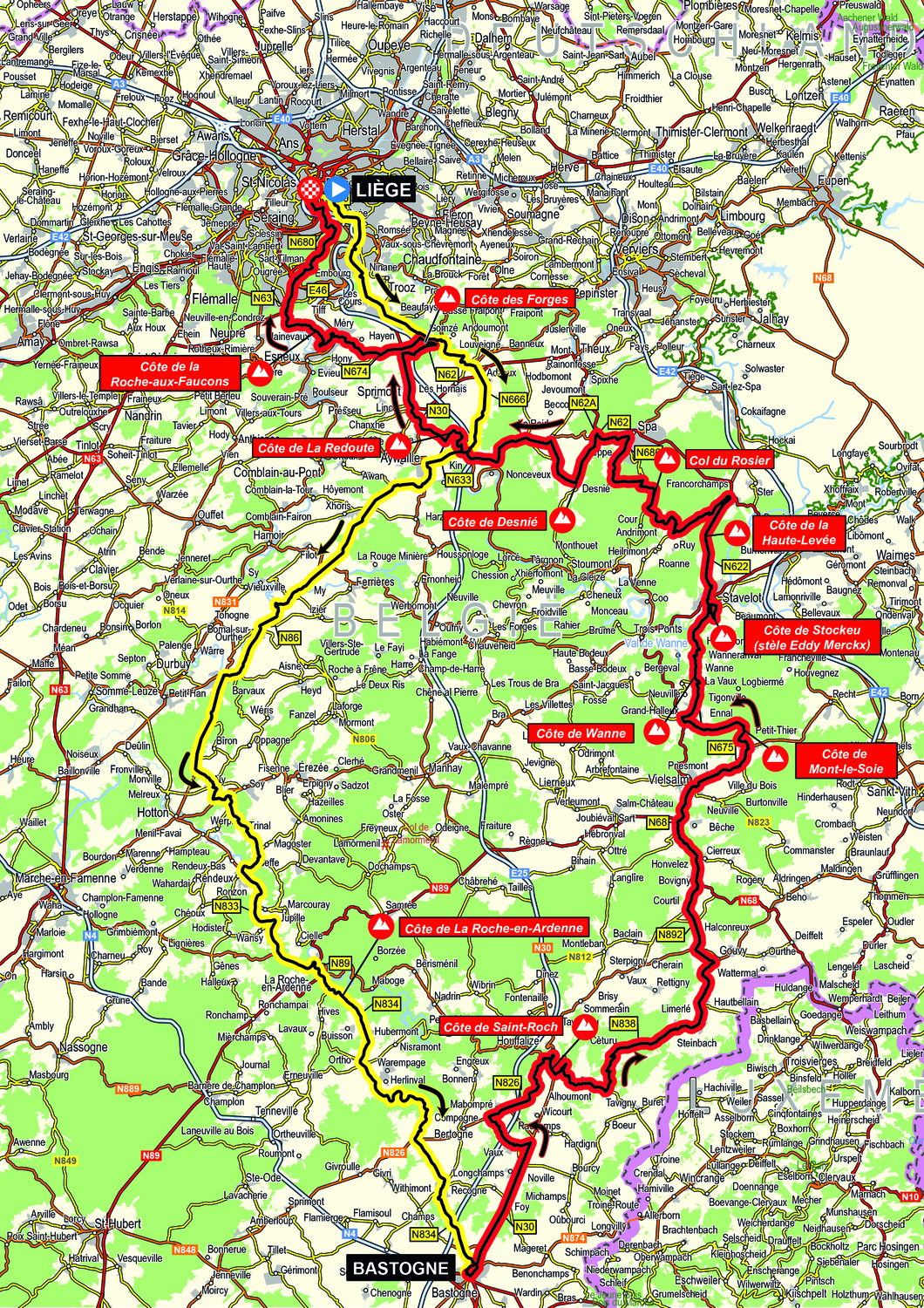
April 24 update: The oldest running major classic, Liège-Bastogne-Liège dates from 1892, when men were men and bike races were very very long. Known as La Doyenne in tribute to its age though perhaps not its wisdom, the Ardennes monument originally served as a prelude to the more important Liège-Paris-Liège. Its original secondary status likely accounts for its (almost) human scale: The course totals 260 kilometers.
True to its name the race begins in Liège, travels 90 kilometers South to Bastogne, then returns by a different route to Liège. Charleroi serves as the start town, while the finish lies across the Muese river in Ans.
|
The Climbs
Eleven named côtes, none more than three kilometers, give La Doyenne her character. Though they are short, the côtes of the Ardennes are typically steep. Little wonder that Damiano Cunego will rock a 35t inner chainring for the occasion. Here are the main climbs:
• Km 57.5: Côte de Ny 1.8 km avg. 5.7%
• Km 82.0: Côte de la Roche-en-Ardenne 2.8 km avg. 4.9%
• Km 128.0: Côte de Saint Roch 0.8 km avg. 12%
• Km 172.0: Côte de Wanne 2.7 km avg. 7%
• Km 178.5: Côte de Stockeu 1.1 km avg. 10.5%
• Km 184.0: Côte de la Haute-Levée 3.4 km avg. 6%
• Km 196.5: Côte du Rosier 4.0 km avg. 5.9%
• Km 209.0: Côte de la Vecquée 3.1 km avg. 5.9%
• Km 226.5: Côte de la Redoute 2.1 km avg. 8.4%
• Km 241.5: Côte de la Roche aux Faucons 1.5 km avg 9.9%
• Km 255.5: Côte de Saint-Nicolas 1.0 km avg. 11.1%
Where to Win
In a typical year, a sizable group arrives together at the base of La Redoute. There, the real race begins. Named after a battle fought during the French Revolutionary wars, La Redoute lasts 2.1 kilometers and has an average gradient of 8.4%. The average gradient doesn’t tell the whole story, though. Sections of La Redoute wall up to nearly 21%. The climb is plenty sufficient to force a selection, and sometimes the winning move is done and sealed by the summit. In 1999, Frank Vandenbroucke attacked on La Redoute and stayed away to the finish in Ans. More typical is an edition like 2006, when Ivan Basso set a furious tempo up on the climb, whittling the field down to just 15 riders. Alejandro Valverde celebrated his first victory that year. Basso finished tenth.
Philippe Gilbert is always looking for the right moment |
A bumpy 15 kilometers follows La Redoute. Then comes the Côte de la Roche aux Faucons, averaging 9.9% over 1.5 kilometers. Anyone bluffing strength will sit exposed here, as the steep gradient leaves nowhere to hide. In 2008, Andy Schleck attacked on the Côte de la Roche aux Faucons, while his brother Fränk sat on in the chase. Alejandro Valverde won that edition in a three-up sprint, after Davide Rebellin did much of the work to keep Andy Schleck from riding away with the whole burrito.
A steep descent follows the Côte de la Roche aux Faucons, which sometimes leads to a regrouping. From there, the race turns onto a highway to cross the Meuse River. Here is one of the few flat stretches of road in the entire race. If any teams have the legs to chase, this section is often their best hope of bringing back an inconvenient breakaway.
For the attackers, meanwhile, one last chance comes a few kilometers later on the Côte de Saint-Nicolas, a climb of one kilometer averaging 11 percent. From the top of the Côte de Saint-Nicolas, there remains just nine kilometers to ride. This short, steep climb lies in the neighborhood of Tilleur, home to many Italian immigrants. It provided the spring board for Paolo Bettini’s 2002 win, when Bettini and his Mapei team-mate Stefano Garzelli attacked there together. Over the top of the Saint-Nicholas the two Italians held a 10 second gap, enough to survive to the finish. Ivan Basso finished third that year for an all-Italian podium.
Fittingly, Liège-Bastogne-Liège finishes on a climb. The road to the Rue Jean Jaurès rises 65 meters in the final kilometer or so (the profile is not especially precise). I was told there would be no math, but my back of the envelope calculations put the average gradient somewhere in the neighborhood of 6.5%. The finishing climb begins with a steep bite before flattening out at the line. The finish favors riders Alejandro Valverde and Damiano Cunego, who have a big finishing kick. A rider like Cadel Evans or Fränk Schleck will find it much harder to win in Ans, unless they can escape before the finish.
The drawn out, uphill sprint finish suits the two-time champ and last year's L-B-L winner, Alejandro Valvarde, perfectly |
The Favorites
Two-time winner Alejandro Valverde is the hot favorite for Liège-Bastogne-Liège, a race which suits him to perfection. The Caisse d’Épargne rider flourishes in the côtes and has one of the fastest finishes in racing, outside the pure bunch sprinters. Valverde did not show especially well at the Amstel Gold Race last Sunday where he finished outside the top 20, despite significant work on the front by his team-mates. I still don’t quite know what they were trying to accomplish by all that effort. Was the Spanish rider saving his legs last Sunday? Or, is the form just not there?
At Wednesday’s Flèche Wallonne, Valverde moved up the ranks to seventh. It was a better result, but still far from a dominating performance. All the same, it’s hard to dismiss Valverde’s chances of winning at Ans. He will have a strong team to support him, and in a group finish, his sprint is a deadly weapon. Do you have a license for that thing, young man?
Damiano Cunego, by contrast, is considerably less enigmatic. At Amstel, he seemed to hold back, looking for an opportunistic win if it came his way. Always at the front, the Italian never attacked. Lack of legs or waiting for Liège? His interviews suggest the latter, as Cunego consistently says that Liège suits his characteristics.
At Flèche Wallonne, he could not follow the acceleration of winner Davide Rebellin on the Mur de Huy, but still finished third for the second year in a row. The steep finish in Huy does not seem to suit him, or perhaps he needs a few more attempts to learn better to time his effort. All the same, the young Italian is on screaming form and can count on strong team support. Since the beginning of the season, he has named Liège-Bastogne-Liège as one of his main objectives for the season. He may not win, but he will certainly be at the front in the closing kilometers.
Second at Flèche Wallonne, Andy Schleck takes over leadership of Saxo Bank for his injured brother Fränk. Some talk has surfaced that Fränk Schleck may start after all, but after his crash at Amstel, it’s hard to imagine he will bring much in the way of form to Charleroi. In the 2008 edition of Liège, Andy Schleck nearly rode away with the race, while playing the rabbit for Fränk. Andy flattened the steep gradients of the Côte de la Roche aux Faucons, and only the determined efforts of Davide Rebellin could contain him. The younger Schleck finished the day in fourth. To better that result, he will need to escape alone or in a small group. A climber, Schleck will find sprinting against Valverde or Cunego a losing proposition.
Wednesday's winner of Fleche Wallonne, Davide Rebellin, being interviewed after his 2nd place finish at L-B-L last year |
Winner of Flèche Wallonne this year for the third time in his career, Davide Rebellin also deserves mention among the favorites for Liège. In 2004, Rebellin swept the Amstel Gold Race, Flèche Wallonne, and Liège-Bastogne-Liège. This year, Rebellin did not figure in the finale of the Amstel Gold Race, perhaps saving his legs for the mid-week classic, and ended the day somewhere in the 40s. In last year’s edition of Liège, Rebellin all but towed Valverde to the line, where he promptly lost to the Spanish riders screaming fast sprint. No doubt Rebellin will want to avoid a repeat of that experience, but ridding himself of Valverde may prove difficult.
Over at Silence-Lotto, meanwhile, Philippe Gilbert and Cadel Evans have shared leadership duties this week, and it’s unclear who will lead the team on Sunday. At the Amstel Gold Race, Gilbert won the sprint for fourth just ahead of Damiano Cunego. Certainly, the Belgian, who lives near La Redoute, has good form — he’s already reached the podium of Ronde van Vlaanderen this season. Though Liège runs on his local roads, Gilbert has said that Amstel suits him better.
At Flèche Wallonne, meanwhile, Gilbert rode in service of Cadel Evans, who ended the day in fifth after attacking twice in the finale. Evans still seems not to have mastered the Mur de Huy, repeatedly coming close to victory, but just not quite getting the win. Maybe next time. The Australian, meanwhile, has a mixed record at Liège. His highest finish is fifth, last year, he finished seventh. Evans hasn’t much sprint and has never won a major one day classic, despite several close calls.
Other riders to watch include Serguei Ivanov of Katusha, who won the Amstel Gold Race; classics talent and descending genius Samuel Sanchez of Euskaltel-Euskadi, who finished fourth at Flèche Wallonne; Thomas Lövkvist, who won Monte Paschi Eroica and finished sixth at Flèche Wallonne; Simon Gerrans of Cervélo TestTeam who has consistently finished in the top ten at this week’s races; Michael Albasini also a solid top tenner; Christian Pfannberger, ninth at Amstel Gold Race this year, fifth at Liège-Bastogne-Liège in 2008; and last week’s long-shot shout-out, Vincenzo Nibali who finished 19th at Amstel Gold Race after riding an aggressive race. Nibali said post-race that he is still “in school” when it comes to the major classics.
No Long Shot Shout-out this time around. Really, does anyone unknown ever win Liège? I'm going to say... no.
— Gavia (Thanks to Elvisgoat at podiumcafe.com for reminding me of the Vandenbroucke story.)
more previews...
The Official Site — letour.fr
A coterie of côtes to challenge the champions — cyclingnews
LBL: Ranking the Favorites! — podiumcafe
![]()
Gesink fit voor Luik-Bastenaken-Luik — nos.nl
Just posted April 26th 2009,
66 Big Photos from last year's 2008 Liège-Bastogne-Liège (
)
Highlights from previous years — sporza.be